The short answer
A visitors visa south africa is for a visitor to South Africa for tourism or business meetings, and working on it is not allowed. Whether you need one depends on your passport nationality: some passports enter visa-free, while others must apply before travel through a mission, VFS Global, or online. A visit is typically granted for up to 90 days.
First, get the direction right: this visa is for visiting South Africa
This guide covers one direction only: a foreign national coming INTO South Africa. That point matters, because two other guides on this site cover the opposite direction, and readers often land on the wrong one.
If you are a South African travelling OUT to other countries without a visa, that is a different topic. See the visa-free countries guide. If you are a South African applying for a UK visa, that is also a different topic. See the UK visa guide. Neither guide helps a foreign visitor who needs permission to enter South Africa, and this guide does not help a South African planning an outbound trip.
South Africa tourist visa: the same permission, not a second visa
The official DHA term is "visitor’s visa". Many readers search for South Africa tourist visa, and many guides use that phrase. It is the same permission, not a second visa type. This guide uses "visitor’s visa" as the official term and "tourist visa" only as the everyday phrase for the same thing. The legal base is Section 11 of the Immigration Act 13 of 2002, so you will also see the phrase visitor’s visa Section 11 in law-firm guides.
One more direction warning: a visa-required traveller cannot collect a visa on arrival. DHA states this plainly on its visas page, checked 4 November 2026: visas are not issued at South African ports of entry, and airline officials must insist on a visa before allowing passengers to board. If you arrive without a visa you need, immigration officials are obliged to put you on a flight back to your home country. Older pages that suggest a visa can be picked up at immigration control on entry are wrong for visa-required nationalities. Apply before you travel.
Visitors visa South Africa: do you need one?
Start with your passport, not with where you live. DHA’s rule is that the passport nationality decides the route. A person who lives in a visa-exempt country but holds a visa-required passport still needs a visa, and a person who lives in a visa-required country but holds a visa-exempt passport may not. Check the passport you will travel on.
There are three routes, and the decision tree below puts you in one of them in under a minute.
Route 1: visa exempt entry
Route 1: Visa-exempt entry. Your ordinary passport is on DHA’s exemption list, and you enter for the period that list gives for your passport type, usually 30 days or 90 days. You still need a valid passport, funds, and a return or onward ticket, and the immigration officer at the port of entry still decides admission and the length of stay for that visit. Exempt does not mean unchecked.
Route 2: online ETA or eVisa route
Route 2: Online ETA or eVisa route, where it applies to your nationality. The Electronic Travel Authorisation (ETA) is an online pre-travel authorisation, not a sticker in your passport. It launched on 12 August 2026, first for China, India, Indonesia, and Mexico, and later summaries report it expanding to further visa-required nationalities through September 2026. Check the ETA portal at eta.dha.gov.za for your nationality on the day you apply, because the rollout list has changed in phases and a guide written one month can be out of date the next. The older eVisa portal has also been used for some nationalities. If the ETA portal does not list your nationality, use Route 3. Do not assume the online route covers you.
Route 3: mission or VFS visa before travel
Route 3: Mission or VFS visa before travel. If your ordinary passport is not exempt and the online route does not cover your nationality, apply before departure at a South African mission or through a VFS Global centre where that channel applies. VFS Global receives and forwards applications. It does not decide them. DHA decides. That distinction matters when you chase a result: VFS can tell you where your file is, but only DHA can approve it.
Read only the ordinary passport column: the Nigeria worked example
Do not copy a country list from a blog and trust it. DHA’s own exemption list is headed "subject to change without notice", and the version checked for this draft was issued on 9 December 2025. Use the live DHA list, linked in the final section, and read only the "ordinary passport" column. DHA’s table has separate columns for diplomatic, official, service, ordinary, and special passports, and reading the wrong column causes real mistakes. A published summary of the DHA list gives Nigeria as the worked example: the diplomatic, official, and service columns show 90 days, but the ordinary column is blank, which means an ordinary Nigerian passport needs a visa. If you read the first column you see, you will get Nigeria wrong.
90 days per visit or per calendar year: check the P/A marker
The length of an exempt stay is also not the same for every nationality. Summaries of the DHA list give most exempt nationalities 90 days per visit, give some nationalities 30 days, and give a smaller group, including Kenya, Ghana, and Tanzania, 90 days per calendar year rather than per visit. DHA marks some rows "P/A", meaning per annum. That difference matters: a traveller who has already used 90 days in a calendar year cannot assume a fresh 90 days on the next trip. Check your own country row on the live DHA list, including any P/A marker, before you book.
South Africa visa exempt countries: categories, not the full list
The South Africa visa exempt countries question therefore has no safe short list in a blog. Categories are stable enough to explain, but the list itself moves, and DHA says so on the list itself. This guide gives you the categories and the official list link, and it does not reproduce the full list.
What a visitor’s visa lets you do, and what it does not
Granted purposes: tourism, family, business, and more
DHA states on its visas page, checked 4 November 2026, that South African visitors’ visas are for international travellers who have permanent residence outside South Africa and who wish to visit on a temporary basis for tourism or business purposes for a period of 90 days or less. DHA’s granted-purposes list is wider than a holiday alone. It includes visits to family or friends, business purposes, a spouse joining a spouse who is in South Africa on a work or study visa, children joining parents who are in South Africa on work or study visas, study purposes, charitable or voluntary activities, research, conferences, work in the production of a movie or show, medical purposes where a patient needs lifesaving treatment (with a three-month maximum for that purpose), and sports events.
What it does not allow is just as important. Visitors are restricted to the activity or purpose for which their visa was issued, and DHA states that entry may be refused if the purpose of the visit is not correctly stated. On a standard visitor’s visa you may not take up employment in South Africa, run an income-generating business in South Africa, or take a study course longer than the visitor’s stay allows. A short business meeting or conference is a visitor purpose. Running a business from inside South Africa is not.
Visitor’s visa Section 11: the four subtypes
Section 11 has four subtypes, and picking the wrong one is a known refusal cause. You only need enough detail to pick the right queue, not a full guide to each one.
- Section 11(1)(a), standard visitor. Tourism, family visits, and short business meetings, up to 90 days. Most readers of this guide belong here.
- Section 11(1)(b), long-stay visitor. Stays over 90 days up to 3 years for specific cases, such as researchers, authors, and self-funded retirees. This is a different application with heavier proof, including funds, medical, and police clearance evidence. Do not apply in this category simply because you want a longer holiday.
- Section 11(2), work endorsement on a visitor’s visa. Short-term, specific work authorised by the Director-General, such as a technician or specialist task, generally up to 90 days. This is not a general right to work. If work is your purpose, you need this endorsement or a work visa, not a standard visitor’s visa.
- Section 11(6), spouse or life partner. A foreign spouse or life partner of a South African citizen or permanent resident. This is a family category with its own proof, not a shortcut to a longer tourist stay.
A visa does not guarantee entry: the officer decides at the port
A visa also does not guarantee entry. DHA states that a visa lets you travel to a South African port of entry, where an immigration officer then decides if you are allowed to enter and for how long you can stay for that visit. On entry, the visa is treated as a visitor’s permit, and its period runs from the date of entry, with the conditions set out on the visa label. Read the label when you arrive. The date on the label, not the date you hoped for, controls your stay.
Guides use both "port of entry visa" and "visitor’s visa" for the same entry document. They are not two separate visas to apply for.
How to apply for a South Africa visitor visa: embassy, VFS Global, or online
The steps below follow the South Africa visitor visa process in order. The channel changes by nationality, but the shape of the process does not.
- Confirm your route first. Check the live DHA exemption list for your ordinary passport, then check the ETA portal for your nationality. Only then pick mission, VFS, or online. Applying through the wrong channel is the most common wasted fee.
- Get the correct form. DHA’s visas page names Form BI-84 as the application for a visa. Some mission and law-firm guides write the same form as DHA-84, and some missions use their own form number on their local page. Use the form your mission or VFS centre gives you, and fill it in the way that centre asks. A form name mismatch on a blog is not a reason to submit the wrong local form.
- Gather the documents in the next section before you book an appointment. Incomplete files are a leading cause of delay and refusal.
- Book and attend the appointment where one applies, and give biometrics where the channel requires them. Some missions take applications in person by prior appointment only, and some countries route all ordinary applications through VFS centres, with the mission taking only diplomatic and official cases. Your mission or VFS centre page states which rule applies to you.
- Pay the fee that applies to your nationality and channel, and keep the payment proof. Fee detail is in the documents section below, because the fee is not one universal number.
- Wait for the DHA decision, and do not make fixed travel plans before the visa is issued. One mission page, the South African High Commission in Canberra, advises allowing 21 working days for processing from receipt and warns against contacting the mission before that period ends. Other channels report different waits, as explained below, so treat any single wait figure with care.
- Check the visa label when it arrives, including the validity dates and the conditions. An error on the label is far easier to raise before travel than at the port of entry.

Processing time: mission dependent, no honest single figure
On processing time, there is no honest single figure. Published waits conflict because they describe different channels and different periods: one mission page gives 21 working days, a VFS country page gives at least 15 working days, a law-firm summary of DHA Circular 30 of 2025 gives 4 to 8 weeks for physical Section 11 submissions, and aggregator guides give up to 60 working days as a Home Affairs standard. Treat the range as mission-dependent, apply well before travel, and use your own mission or VFS centre page as the figure for your case. No guide can promise your wait.
Fees: confirm the visa fee plus the VFS service charge first
On fees, the same caution applies. DHA’s own page says only that a fee is charged, that it is updated annually, and that you should check the cost with the office, because it is payable in different currencies in different countries. Secondary guides that cite the fee amendment of 17 August 2026 report a visitor’s visa tariff of R425 for nationalities that pay, with a separate VFS service charge on top that varies by country and centre. The DHA exemption list fee column also marks some nationalities as fee-exempt, and summaries name India, Egypt, and Mexico in that group. The ETA carries its own reported processing fee of R500 from 17 August 2026, on top of the visa fee where that fee applies. None of those figures should be treated as a total price for your case: confirm the visa fee plus the VFS service charge on your own mission or VFS centre page before you pay, because the service charge differs by location and the fee can change.
Documents checklist
DHA’s visas page, checked 4 November 2026, lists the core documents for a visa application. Mission checklists add local detail, so use this list as the base and your mission page as the final word.
- A passport or travel document valid for no less than 30 days after the expiry of your intended visit. DHA’s entry page requires at least one blank page for endorsements. Some missions ask for two or three blank pages on their local page, so if you can, travel with at least two blank pages rather than relying on the DHA minimum alone. Some missions also flag passports with less than six months of validity, even though the DHA rule is 30 days beyond the visit. If your passport is close to expiry, renew it before you apply.
- A completed Form BI-84, or the form your mission or VFS centre specifies.
- Two colour passport photographs, where the channel requires them.
- Payment of the prescribed fee, with proof of payment.
- A statement or documentation confirming the purpose and duration of your visit. For a family visit, add the host invitation. For business, add the meeting or conference detail. Vague purpose is a refusal reason, so be specific about what you will do and when you will leave.
- A return or onward ticket, or proof of reservation where the mission accepts a reservation rather than a paid ticket. DHA’s entry list requires a return or onward ticket, and one mission page states plainly that entry will not be permitted on a one-way ticket unless the traveller holds a suitable permit or visa. Do not book a one-way ticket and hope the point is not checked.
- Proof of accommodation, or a host invitation with the host’s details where you will stay with family or friends.
- Proof of financial means for your living expenses in South Africa, in the form DHA lists: bank statements, salary advances, undertakings by hosts in South Africa, bursary, medical cover, or cash available including credit cards and travellers’ cheques. On the amount, DHA’s general page says only "sufficient funds". A mission checklist, the Canberra High Commission page, puts a figure on it: recent certified bank statements for the last three months, with a minimum of R3,000 per month per person. Treat R3,000 per month over three months as a mission-published figure, not as a universal DHA tariff, and check whether your mission states its own figure.
- A yellow fever vaccination certificate, if required. DHA requires it where your trip starts in, or passes through, the yellow fever belt of Africa or South America. If your route does not touch that belt, the certificate is not part of your file. If it does, get it before you apply.
- Children documents, where children travel with you. DHA’s visas page lists unabridged birth certificates, proof of guardianship or custody, or consent from the guardian in the case of an unaccompanied minor. The position for accompanied foreign children has been relaxed since a 2019 waiver, and some current guides state that an accompanied foreign child does not routinely need to present a birth certificate or consent affidavit. That relaxation does not remove the need for care: carry the child’s own passport in every case, carry the unabridged birth certificate if you have it, and carry a consent affidavit from a non-travelling parent where a child travels with one parent or with someone other than a parent. If the mission checklist for your case still asks for the certificate, the checklist wins over a general blog claim. See the border section for what to carry on the day.
- For long-stay Section 11(1)(b) cases only, the heavier file: police clearance certificates from countries where you resided for 12 months or longer, a medical report, and proof of funds for the full stay. Standard visitor applicants do not need to build that file, which is another reason to pick the right subtype at the start.
How long can you stay in South Africa on a visitor’s visa?
A standard visitor’s visa is for a period of 90 days or less, in DHA’s own words on its visas page. For a visa-exempt traveller, the stay is the period on the DHA exemption list for that passport type, usually 30 days or 90 days, and for some nationalities 90 days per calendar year rather than per visit, as explained above. For a visa holder, the stay is the period set out under "conditions" on the visa label, counted from the date of entry.
Three dates not to confuse: validity window, entry date, last lawful day
Do not confuse three different dates: the visa validity window (the period in which you may travel to South Africa), the entry date (when your permitted stay starts to run), and the expiry of the permitted stay (the last date you may remain). The label controls all three. If the label gives you fewer days than you asked for, that shorter period is your lawful stay, and the extension section below is your only in-country route to a longer stay. It is not automatic, and it is not a second visa on arrival.
ETA stays and designated airports
The ETA position is similar in length but different in form. Secondary summaries report the ETA as valid for up to six months with multiple entries, with each stay limited to 90 days, and entry only through designated airports: O.R. Tambo, Cape Town, King Shaka, and Lanseria. That airport limit is reported across ETA guides, so if you plan to enter by land or through another airport, do not assume the ETA covers that arrival. Check the ETA portal for the entry points that apply to your authorisation.
How to extend a visitor visa in South Africa
VFS Global South Africa visitor visa extension: VFS receives, DHA decides
This is the extend visitor visa South Africa route: an in-country application to stay longer, lodged through a VFS Global centre in South Africa, and decided by DHA. The VFS Global South Africa visitor visa extension process follows the same split as a first application: VFS receives the file and takes biometrics, DHA decides the outcome.
The standard extension picture, across law-firm and practitioner guides, is one extension of up to a further 90 days, giving a total of up to 180 days. That "once, up to 90 more days" shape is the working rule for a standard visitor, but it is discretionary, not an entitlement. DHA can refuse an extension, and an extension only continues the same purpose. It does not convert a visit into work or study, and it does not create a new visa category. If your purpose has changed, you need advice on the correct category, not a longer visitor’s visa.
Directive 13 of 2026: the 60 day rule waived, valid visa still required
The deadline is where older guides go wrong, and this draft corrects them. Older guides, including a currently live Intergate page, still state that an extension must be submitted at least 60 days before the current visa expires. That 60-day rule came from Regulation 9(8)(c). On 2 October 2026 the Minister of Home Affairs signed Immigration Directive 13 of 2026, which waives the 60-day advance filing requirement for covered extension and change-of-status applications. Multiple law-firm summaries of the directive agree on the core points: the waiver covers pending applications and future covered applications, it has no stated end date, the underlying regulations have not been repealed, and the one firm condition is that the application must be submitted while the existing visa is still valid. An application lodged after expiry is not covered by the waiver.
The practical advice therefore has two halves, and both matter. First, the waiver means a late application is no longer refused for timing alone, provided the visa was still valid on the day you lodged it. Second, the waiver is not a reason to wait. VFS appointments, documents, and biometrics take time, the waiver can be withdrawn, and some older DHA material still prints the 60-day rule, so a reader who waits until the last days risks a wasted trip to VFS. Apply as early as your stay allows, and never after expiry. One related timing point needs a hedge: for visas issued for less than 30 days, older material requires lodgement no later than seven working days before expiry. One current practitioner summary treats that short-stay timing as a practice recommendation rather than a rule expressly addressed by Directive 13. If your visa is for less than 30 days, apply at least seven working days before expiry to stay safe on either reading.
While your extension is pending: keep the receipt and stay put
While an extension is pending, keep your VFS submission receipt and a copy of the application with you at all times. Practitioner guides agree that a person who has properly lodged an in-country extension may remain in South Africa while DHA considers it, and that the receipt is the proof of a pending application. Do not treat a pending application as a travel document. Guides warn that leaving South Africa while an extension is pending can lead to overstay consequences at the port of exit, and a pending application does not guarantee re-entry. A separate, time-limited concession in Immigration Directive 7 of 2026 extended lawful stay to 30 June 2027 for certain pending long-term visa, waiver, and appeal cases lodged through VFS and pending on 30 March 2026. That concession is not a general promise for every standard visitor extension, so do not rely on it for a standard case. Stay, keep the receipt, and wait for the decision.
Extension waits are reported, not official, and they are long. One dedicated extension guide reports 8 to 10 weeks based on the author’s experience. Plan for a wait of that order, keep your funds and accommodation proof current for the extended period, and do not book non-refundable onward travel that assumes an early decision.
Common refusal reasons, and how to avoid them
Most refusals are file problems, not bad luck. The list below follows the refusal themes across mission checklists and practitioner guides, with the fix for each one.
- Insufficient or unclear funds. Fix: recent bank statements that cover the full stay, at the mission figure where one is published, with a balance that matches the trip you describe. A statement that ends weeks before you apply, or a balance that cannot cover the stay, invites a refusal.
- Missing or inconsistent documents. Fix: work through the mission checklist line by line, and make every document say the same thing about dates, names, and purpose. A hotel booking for one city, an invitation for another, and a ticket for a third date range reads as an inconsistent trip.
- Vague purpose. Fix: state what you will do, where you will stay, and when you will leave, with documents that match. "Tourism" with no accommodation, no itinerary, and no return plan is a weak file.
- A one-way ticket with no onward plan. Fix: hold a return or onward ticket, or proof of reservation where the mission accepts it, before you apply.
- Wrong subtype. Fix: if you want to work, study long-term, or stay over 90 days for a specific long-stay reason, apply in the right category from the start. A standard visitor application that hides a work purpose risks refusal and a record that harms the next application.
- Previous overstay or breach. Fix: disclose it, and do not apply as if it did not happen. A prior overstay is covered in the next section, and it affects future applications even after the ban period ends.
- Weak home-country ties. Fix: show employment, family, property, or other obligations that support a temporary visit and a return home. DHA treats each application on its own facts, so ties evidence helps where the trip itself is short and simple.
A refusal is not the end of the road, but it is not a formality either. Check whether your refusal letter gives an appeal route and a deadline, keep the full refusal record, and fix the named reason before you re-apply. A fresh application that repeats the same weak file usually repeats the same result.
What happens if you overstay a visitor’s visa in South Africa?
Overstaying is the most expensive mistake in this guide, because the consequence is not a fine at the airport. It is a declaration that follows you.
Regulation 27(3) ban periods in force today
Under Section 30(1)(h) of the Immigration Act and Regulation 27(3) of the Immigration Regulations, a person who overstays may be declared an undesirable person, and the declaration is normally issued at departure on a Form 19. The ban periods in the current regulation, as summarised consistently across current law-firm guides, are: an overstay of not more than 30 days, 12 months; a second overstay within 24 months, 2 years; and an overstay of more than 30 days, 5 years. A declaration blocks re-entry and future applications for that period, not just the current trip.
The older scheme is outdated: do not use it
Older figures still circulate, and this draft does not repeat them as current law. Some older guides give 2 years for up to 30 days, 3 years for 30 to 90 days, and 10 years for over 90 days. That older scheme conflicts with the current Regulation 27(3) summaries, and the current scheme above is the one to work from. If a guide you read still shows the older scheme, treat that guide as out of date on this point.
Waiver and appeal window: discretionary relief, act within days
Two further points matter. First, the Act allows the Director-General, on application and for good cause, to declare that a person is not undesirable under Section 30(2). That is a discretionary waiver, not an entitlement, and it needs a proper application with reasons. Second, practitioner guides report an overstay appeal window of ten working days from the Form 19. That window is reported, not confirmed on an official page checked for this draft, so if you receive a Form 19, act within days, keep the form, and take advice at once rather than waiting to test the deadline.
The only safe responses to a looming overstay are the ones in the extension section: lodge an extension while the visa is still valid, or leave before it expires. There is no grace period in this guide, because no official page checked for this draft promises one. A single day past expiry can trigger the declaration process, so do not treat the expiry date as approximate.
At the border: what to have ready
Admission is decided at the port of entry, even for a visa holder and even for a visa-exempt traveller. Pack for that check as a separate step from the visa application, because the officer checks the trip, not just the visa label.
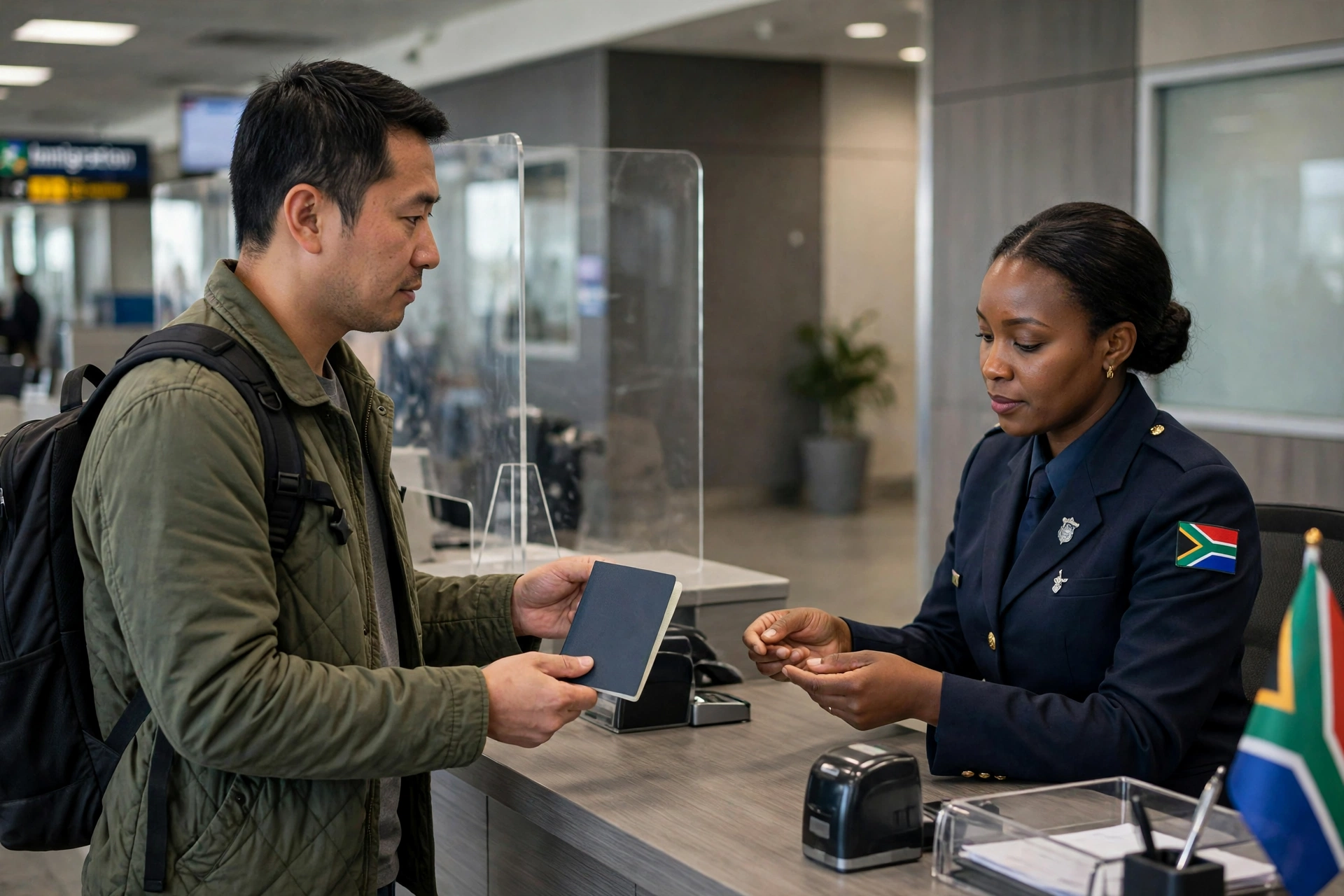
- Your passport, with the visa or ETA authorisation where one applies, and at least one blank page for endorsements.
- Your return or onward ticket, in a form you can show on a phone or on paper.
- Proof of accommodation or your host invitation, with the host’s contact details.
- Proof of funds for day-to-day expenses during the stay, in the form DHA’s entry list requires: sufficient funds to pay for your expenses while you are in South Africa.
- A yellow fever certificate, if your trip starts in or passes through the yellow fever belt of Africa or South America.
- The SARS online traveller declaration. From 1 July 2026, SARS requires all travellers entering or leaving South Africa through air, land, sea, and rail ports of entry to submit an online traveller declaration before travelling, through the SARS Traveller Management System, the SATMS app, or a scan-to-declare code. SARS states that you must submit it no more than 24 hours before departure from the country you travel from, or before the last leg directly to South Africa where your trip has stops. SARS also states that travellers will not be denied entry or departure solely because they have not completed a declaration before arriving at a port of entry, which means a missed declaration is fixed at the port rather than punished with refusal, but the declaration duty itself is now the rule. Complete it in the 24-hour window, keep the emailed confirmation, and declare goods and currency as the form asks. The declaration is a customs step, not a visa step, and it does not replace a visa or an ETA.
- Children documents, as described in the checklist section: each child’s own passport, plus the unabridged birth certificate and any consent affidavit your mission checklist asks for. Carry them even where a general guide says an accompanied foreign child may not routinely be asked for them, because the cost of carrying them is small and the cost of missing them at the border is a delayed or refused entry for the child.
Answer the officer’s questions in line with your visa purpose. If your purpose on arrival differs from the purpose on your application, say so plainly and expect questions. An inconsistent purpose at the border is a refusal risk even with a valid visa in hand.
Frequently asked questions
Do I need a visa to visit South Africa?
It depends on your passport nationality. Check the live DHA exemption list for your ordinary passport. If your passport is exempt for your stay, you do not need a visa for that visit. If it is not exempt, and the ETA portal does not cover your nationality, you must apply for a visitors visa south africa before travel through a mission or VFS Global. Visa-required travellers cannot collect a visa on arrival.
How long can I stay in South Africa on a visitor’s visa?
A standard visit is typically granted for up to 90 days. For a visa-exempt traveller, the stay is the period on the DHA exemption list for that passport type, usually 30 or 90 days, and for some nationalities 90 days per calendar year. For a visa holder, the stay is the period under "conditions" on the visa label, counted from the date of entry.
Can I extend my visitor’s visa while I am in South Africa?
Yes, in the usual case, once, for up to a further 90 days, through a VFS Global South Africa visitor visa extension application decided by DHA. The old 60-day advance rule was waived by Immigration Directive 13 of 2026, signed 2 October 2026, but the application must still be lodged while your current visa is valid. An extension is discretionary, it only continues the same purpose, and it does not convert a visit into work or study. Keep your VFS receipt while the decision is pending, and do not leave South Africa on the assumption that a pending application guarantees re-entry.
Can I work in South Africa on a visitor’s visa?
No, not on a standard visitor’s visa. Short business meetings and conferences are visitor purposes, but employment and income-generating business in South Africa are not. Short-term specific work needs a Section 11(2) work endorsement or a work visa.
How do I apply for a South Africa visitor’s visa: embassy, VFS Global, or online?
Confirm your route first: DHA exemption list, then the ETA portal for your nationality. If you are exempt, you travel on the exemption, subject to admission at the port of entry. If the ETA covers your nationality, apply online through eta.dha.gov.za and check the designated entry airports for your authorisation. Otherwise, apply before departure through a mission or a VFS Global centre, using the form and checklist that mission or centre gives you. VFS receives and forwards the file. DHA decides it.
What documents do I need for a South Africa visitor’s visa?
A passport valid for at least 30 days beyond your intended visit with at least one blank page, Form BI-84 or your mission’s form, passport photographs where required, proof of the prescribed fee, a purpose statement with accommodation proof or a host invitation, a return or onward ticket, proof of funds for the stay, and a yellow fever certificate where your route requires one. Children travelling with you need their own passports, plus the unabridged birth certificate and consent documents your mission checklist asks for.
What happens if I overstay my visitor’s visa in South Africa?
You risk being declared an undesirable person at departure on a Form 19, with a re-entry ban under Regulation 27(3): 12 months for an overstay of not more than 30 days, 2 years for a second overstay within 24 months, and 5 years for an overstay of more than 30 days. A Section 30(2) waiver for good cause is discretionary, not automatic. Lodge an extension while your visa is still valid, or leave before it expires.
What documents do children need to travel to South Africa?
Each child needs their own passport. DHA’s visa checklist lists unabridged birth certificates, proof of guardianship or custody, or consent from the guardian for an unaccompanied minor. Accompanied foreign children have had routine birth certificate and consent requirements relaxed since a 2019 waiver, but the safe course is to carry the unabridged birth certificate if you have it, plus a consent affidavit from a non-travelling parent where a child travels with one parent or with someone other than a parent.
Before you apply checklist and official sources
Work through this list in order, and do not book fixed travel until the visa or authorisation is in hand.
- Confirm the direction: you are a foreign national visiting South Africa, not a South African travelling out.
- Check your ordinary passport row on the live DHA exemption list, including any per annum marker, and note whether you are exempt, ETA-covered, or visa-required.
- Check the ETA portal for your nationality and for the entry airports your authorisation covers.
- Pick the right Section 11 subtype before you fill in any form.
- Build the file from your mission or VFS centre checklist, not from a blog list alone, and make dates, names, and purpose consistent across every document.
- Confirm the fee for your nationality and channel, including any VFS service charge, on your mission or VFS centre page before you pay.
- Apply early, allow for a mission-dependent wait, and do not make fixed travel plans before the visa is issued.
- If you are already in South Africa and need longer, lodge an extension while your visa is still valid, keep the VFS receipt, and do not travel on a pending application without advice.
- Before you fly, complete the SARS online traveller declaration in the 24 hours before departure on your last leg to South Africa, and pack the border documents listed above.
Official sources, all checked 4 November 2026 unless a different date is given:
- DHA visas page: dha.gov.za (visitors’ visas for 90 days or less, Form BI-84, passport 30 days beyond the visit, one blank page, no visas at ports of entry, purposes list, children documents)
- DHA exempt countries page: dha.gov.za (exemption list issued 9 December 2025, subject to change without notice, separate passport-type columns)
- ETA portal: eta.dha.gov.za (check your nationality and entry points on the day you apply)
- VFS Global DHA portal: visa.vfsglobal.com (submission channel for DHA visas; VFS receives and forwards, DHA decides)
- South African High Commission in Canberra mission page: dirco.gov.za (21 working days processing, three months bank statements, R3,000 per month per person figure, three blank pages on that mission page)
- SARS traveller declaration FAQs: sars.gov.za (online declaration required from 1 July 2026, 24-hour window, no refusal of entry solely for a missed pre-arrival declaration; FAQ page updated 3 July 2026)
- Immigration Directive 13 of 2026, signed 2 October 2026, as summarised by IBN Immigration and Intergate Immigration (60-day rule waived, application must still be lodged while the visa is valid, no stated end date, regulations not repealed)
- Immigration Directive 7 of 2026, as summarised by practitioner guides (pending long-term visa, waiver, and appeal concession to 30 June 2027 for cases pending on 30 March 2026; not a general standard visitor extension promise)
- Regulation 27(3) ban periods, as summarised consistently across current law-firm guides (12 months, 2 years for a second overstay within 24 months, 5 years)
- ETA launch and fee, as reported across ETA guides (launch 12 August 2026, first nationalities China, India, Indonesia, Mexico, R500 processing fee from 17 August 2026, designated airports O.R. Tambo, Cape Town, King Shaka, Lanseria)
- Visitor’s visa tariff R425, as reported by guides citing the fee amendment of 17 August 2026 (confirm on your mission or VFS centre page; fee-exempt nationalities and VFS service charges vary)
On this site, the pages that fit with this guide are the home affairs online booking guide for planning an in-person Home Affairs visit, the home affairs contact and locations guide for official help and locations, and the home affairs operating hours guide to check hours before any in-person visit. Those links are for in-person visits only. An in-country visitor’s visa extension is lodged through VFS Global, not booked through a Home Affairs branch booking page, so do not use those guides as the extension route itself.
Disclosure: This article is an independent guide. It is not published by the Department of Home Affairs, the Department of International Relations and Cooperation, VFS Global, or the South African Revenue Service. Visa categories, exemption lists, fees, and processing times change, so confirm the current position on the official pages linked above before you pay, apply, or travel.