The short answer
A South African police clearance certificate is issued by the South African Police Service, not Home Affairs, after your fingerprints are checked against the national criminal record database. The SAPS fee is R190 per application, and SAPS states approximately 15 working days from receipt of a complete application in Pretoria, but a backlog can extend the wait, so apply early.
What is a police clearance certificate in South Africa?
This guide covers the police clearance certificate South Africa process: what the document is, what it costs, how long it takes, and how to apply. A South Africa police clearance certificate states whether any criminal convictions have been recorded against you. The check is fingerprint based: your fingerprints are compared with the national criminal record database, and the certificate reports the result.
What the certificate does not show
The South Africa police clearance system has one issuer and one queue, in Pretoria. The certificate is not a police case report, not a local name check, and not a letter saying you are a person of good character. It does not list arrests that did not lead to a conviction, and it does not list investigations. If a conviction is recorded, the certificate will say so. That does not make it invalid. The employer, embassy, or authority that asked for it decides what the record means.
Who issues police clearance in South Africa: SAPS, not Home Affairs
For police clearance South Africa applications, only one office issues the certificate. It is the Criminal Record and Crime Scene Management division (CR and CSM) of SAPS, in Pretoria. Your local police station does not issue it. The station takes your fingerprints, checks your identity document, and forwards your application to Pretoria at no extra cost to you. You can also deliver the application in person in Pretoria, or send it by post or courier at your own cost.
Home Affairs does not issue this certificate, and no Home Affairs branch or online booking portal can produce one for you. Home Affairs enters the picture only as a requesting authority. Some DHA visa and permit checklists ask you to submit a police clearance certificate with your application.
How Much Is Police Clearance in South Africa?
How much is police clearance in South Africa? The SAPS fee is R190 per application, non-refundable, as published on the SAPS police clearance page and checked on 4 November 2026. Keep every other cost on a separate line.
SAPS fee and other costs in one table
| Cost item | Amount | Source and note |
|---|---|---|
| SAPS fee, per application | R190, non-refundable | SAPS page, checked 4 November 2026 |
| Station fingerprint charge | Not on the SAPS page; third-party guides report around R59, varies | Ask the station first |
| VFS Global submission service | SAPS fee plus a reported service fee around R185 to R200 | Third-party guides only; VFS forwards to Pretoria, does not decide |
| Post or courier to Pretoria | Your own cost | SAPS page; station forwarding is free |
| DIRCO legalisation | No fee on the DIRCO page in the sections checked; third-party guides report the counter service as free | Confirm on the DIRCO page |
| Agent service fee | Varies widely | Separate from the SAPS fee; agents cannot shorten the SAPS queue |
How to pay the R190 fee
Pay in cash at the nearest police station. You can also pay by electronic transfer to the SAPS account. The account is in favour of the National Commissioner of the South African Police Service. The details are ABSA cheque account 4054522787, branch code 632005, Swift code ABSAZAJJXXX. For an electronic payment, use the reference "PCC" followed by your initials and surname. A wrong reference is one of the most common reasons an application stalls.
One application, one certificate
The fee is charged per application, so budget per certificate. One application produces one certificate. Old figures still circulate: an old SAPS page shows R59, and some third-party guides still show R91 or other old amounts. Those figures are outdated. Do not pay them. Confirm the current tariff on the SAPS page before you pay.
Documents and requirements checklist for a police clearance certificate
Incomplete applications are not processed, and SAPS sends an SMS to the applicant in that case. Use this list before you leave for the station.
- Completed SAPS police clearance application form, every field filled in
- Full set of fingerprints on the SAPS 91(a) form, taken by a SAPS officer
- Certified copy of your identity document or passport, plus the original to present at the station
- Proof of payment of R190, with the correct reference
- Documentary proof of a maiden surname or other surname, if it must appear on the certificate
- A South African cell number, if you have one, for SMS updates
- Your collection choice, stated on the application form
Scanned copies of fingerprints, photocopied prints, and digital prints are not processed, and completed certificates are not scanned and emailed to applicants.
How to Get Police Clearance in South Africa
Here is how to get police clearance in South Africa, step by step. Your South Africa police clearance certificate application follows the same path wherever you live in the country. Every application ends up in the same Pretoria queue.
- Get the forms. You need the SAPS police clearance application form and the SAPS 91(a) fingerprint form. Both are available at any SAPS station. The application form is also downloadable from saps.gov.za. Complete every field. If a maiden surname or other surname must appear on the certificate, say so. Attach documentary proof. For example, attach a certified copy of a marriage certificate.
- Pay the R190 fee and keep the proof of payment, using the reference "PCC" followed by your initials and surname for an electronic payment.
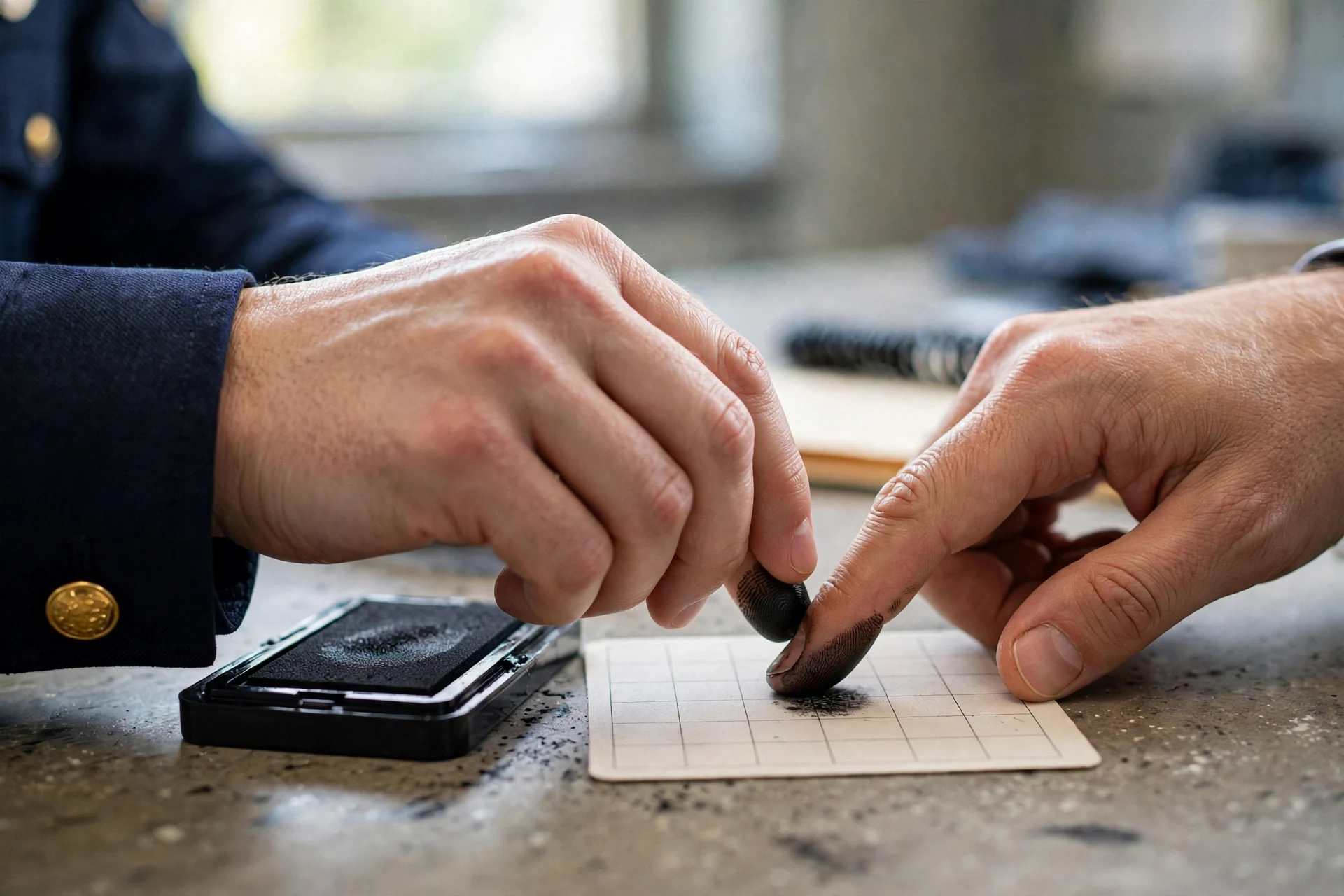
- Go to a SAPS station with your original identity document or passport. A SAPS officer takes a full set of your fingerprints on the SAPS 91(a) form. Present your original document at the station and attach a certified copy of it to the application.
- Submit the pack. Ask the station to forward it to CR and CSM in Pretoria at no extra cost. You can also deliver it in person to the CRC Client Service Centre, Bothongo Plaza West, 1st Floor, Room 14, 271 Francis Baard Street, Pretoria. You can also post it to Private Bag X308, Pretoria, 0001. Or send it by courier at your own cost.
- Give a South African cell number on the application if you have one. SAPS sends an SMS acknowledging receipt, with the reference number for your certificate, and a follow-up SMS when the application is complete.
- Arrange collection as indicated on your application form. The certificate is handed only to you, to a person you nominated, or to your chosen courier service. Proof of identity must be presented at collection.
Can you apply for police clearance online in South Africa?
What you can do online
No, not as a full online application. You can download the application form from saps.gov.za, and you can check the status of a submitted application through the SAPS online enquiry page. What you cannot do online is give your fingerprints. Fingerprints must be taken in person, on the SAPS 91(a) form, by a SAPS officer or, outside South Africa, by an authorised fingerprint service. That single requirement rules out a fully online application.
Agents and VFS submit your pack but do not shorten the queue
Be careful with sellers who advertise an instant online clearance, an online-only clearance, or a clearance with no fingerprints. SAPS does not offer that product. A private background check bought online is not a SAPS police clearance certificate. An embassy or employer that asked for a SAPS certificate will not accept it as one. The SAPS page publishes only the standard processing time, and no faster official service is published there. An agent can submit your pack and collect the result for you, but the agent waits in the same Pretoria queue as everyone else.
How Long Does a Police Clearance Take in South Africa?
The official 15 working day count
How long does a police clearance take in South Africa? SAPS states that finalisation takes approximately 15 working days. The count starts from the date when all required documents are received at Criminal Record and Crime Scene Management. This time frame excludes postal time. Three conditions hide in that sentence. The clock starts when a complete application reaches Pretoria, not when you visit your local station and not when you post the pack. Postal and courier time sits outside the 15 working days, on both legs of the trip. And the word is approximately, not guaranteed.
Backlog and realistic waiting time
The SAPS page also carries a backlog warning. It was active at the time of checking on 4 November 2026. It states that CR and CSM is experiencing a backlog which has extended the waiting period for finalisation. Third-party guides report a longer real wait. In ordinary periods, the total is around 6 to 8 weeks. Some law-firm guides report 2 to 3 months for applications made inside South Africa. They report 3 to 6 months for applications made from abroad. Those are reported experiences, not official promises. Apply as early as your receiving authority allows, and do not book non-refundable travel around the 15 working day figure.
Applying for police clearance from outside South Africa
Fingerprints and payment from outside South Africa
If you live outside South Africa, have your fingerprints taken at any police station in the country where you live. You can also have them taken at a South African embassy. Use the official fingerprint form of that country. If available, use the SAPS 91(a) form. Complete the SAPS application form. Attach a certified copy of your identity document or passport. Pay the R190 fee by electronic transfer. Use the same ABSA details and the "PCC" reference described above.
Abroad applications are not returned to you
Forward the application and required documents directly to CR and CSM in Pretoria yourself. Then note the hard rule, in the SAPS page's own words: applications received from abroad will not be returned to the applicant. You must arrange collection as indicated on the application form, through a person you nominate or a courier service you choose. The certificate is handed only to that nominated person or courier. Plan for that collection step before you send the pack, because an uncollected certificate is destroyed three months after finalisation (see the tracking section below).
Tracking without a South African cell number
SMS updates are available only for South African cell numbers. If you do not have one, track the application through the SAPS online enquiry page. Use your enquiry number and your date of birth. Or use your surname and date of birth. Allow postal time in both directions on top of the Pretoria processing time. This is why third-party guides report 3 to 6 months as a realistic total for applications made from abroad.
How long is a police clearance certificate valid in South Africa?
SAPS does not print an expiry period on the certificate, and the SAPS page sets no validity period of its own. That does not mean the certificate lasts forever. It means the authority receiving it decides how recent it must be. In practice, that decision is usually six months, and two official sources state the rule in writing.
Six months in practice: DIRCO and DHA rules
DIRCO states on its legalisation page that original police clearance certificates submitted for legalisation must be no older than six months. It adds the note that a police clearance certificate is only valid for six months from date of issue. DHA states the same six-month rule for visa and permit applications. A general work visa checklist (effective 9 October 2024) requires a police clearance certificate. The certificate must not be older than six months at the time of its submission. The general work permit checklist states the same six-month rule. Treat six months from the date of issue as the working limit, and confirm the exact rule with the authority that asked for your certificate.
Timing your application inside the six month window
This is also why timing matters. Apply too early and the certificate may pass six months before your DHA or embassy submission. Apply too late and the SAPS backlog may eat your deadline. Apply early enough for the backlog, but close enough to your submission date that the certificate is still inside six months when you submit it.
When Home Affairs asks for a police clearance certificate
This section is a short cross-reference only. The full visa and permit processes are not covered here, and the full police clearance process is not repeated in those guides.
Work visa and permanent residence rules
For a general work visa, DHA requires a police clearance certificate. It must come from the police or security authority of each country. This covers each country where you resided for longer than 12 months in the last five years before submitting. The certificate must not be older than six months at submission. For a general work permit on the permanent residence track, DHA requires a police clearance certificate. It must come from each country where you resided for 12 months or longer after attaining the age of 18 years, except for South Africa. The certificate must not be older than six months at submission. DHA also states that the foreign-country certificate is not required from a foreign country in the case of a renewal or extension of a visa. Note the difference. The work visa rule looks at the last five years. The permanent residence rule looks back to age 18 and excludes South Africa itself. Check the checklist for your exact application type, because the two rules are not interchangeable.
Study visa and naturalisation notes
Study visa checklists follow the same pattern as described in third-party summaries of DHA requirements. The pattern is a clearance from each country where you resided for 12 months or more since age 18. The clearance must not be older than six months at submission. Confirm that wording against your own visa checklist before you apply. For naturalisation, third-party summaries of DHA checklists refer to a SAP 91 fingerprint set. The set is for a police clearance report for applicants aged 18 years and older. The summaries also mention clearances from the countries of your nationality. That wording differs from the police clearance certificate described in this guide, so confirm the current DHA citizenship checklist before you apply.
Police clearance certificate vs criminal record check vs Police Clearance Report
Three names cause most of the wrong-document mistakes. They are not three names for one document.
| Document | Issued by | Cost (checked 4 November 2026) | Used for |
|---|---|---|---|
| Police Clearance Certificate (PCC) | SAPS CR and CSM, Pretoria only | R190 per application, non-refundable | Emigration, travel abroad, employment abroad, DHA or embassy applications |
| Police Clearance Report (PCR) | Any Local Criminal Record Centre (LCRC) | R95 per report | Confirmation of criminal status for expungement |
| A "criminal record check" | No single issuer; a general phrase | Varies | Private or employment screening; not a SAPS document name |
Why the cheaper report is the wrong document
The PCR is the trap. It is cheaper, it is issued locally, and its name sounds close to the PCC, but its stated purpose on the SAPS page is expungement. It is handed to the applicant in person on collection, with proof of identity required. If an embassy, employer, or DHA checklist asks for a police clearance certificate, do not submit a PCR in its place. The only exception is if the receiving authority confirms in writing that it will accept it. A "criminal record check" bought from a private company sits in the same position. It may be useful for screening. But it is not a SAPS certificate.
Using your police clearance certificate abroad: apostille or authentication
Apostille or authentication: which one you need
SAPS does not apostille documents. Does the country where you will use the certificate belong to the Hague Convention of 5 October 1961 (the Apostille Convention)? If it does, you need an Apostille Certificate. If it is not a signatory, you need a Certificate of Authentication. Both are issued by the DIRCO Legalisation Section in Pretoria. The document must be the original. It must be signed and stamped by SAPS Criminal Record Centre. It must be no older than six months.

DIRCO submission routes and collection
DIRCO's Legalisation Section sits at the OR Tambo Building, 460 Soutpansberg Road, Rietondale, Pretoria, 0084, with postal address Private Bag X152, Pretoria, 0001. DIRCO offers four submission routes, as published on its legalisation page and checked on 4 November 2026. In person, through an online booking system, with appointments available daily except Wednesdays from 08:30; the walk-in service was discontinued from 1 September 2026. By courier, with a cover letter stating the destination country, so DIRCO can establish whether an apostille or an authentication is required. Through a registered agent, noting that DIRCO lists registered service providers for information only and does not endorse them. You can also apply through a South African diplomatic or consular representative abroad. The mission sends it on by diplomatic bag. Confirm with the mission first whether that service is available.
Collection runs from 08:30 to 12:15 daily except Wednesday, with no booking required for collection. Present the confirmation email and reference number at security and to DIRCO staff. Check your spam folder for the completion email, as DIRCO itself advises. If someone else collects for you, that person needs a letter of authority, or the documents will not be released.
Warnings before you submit to DIRCO
Two warnings belong here. DIRCO accepts only the original certificate. A certified copy is not accepted for legalisation, and a certificate older than six months is not accepted either. DIRCO also warns against using unregistered agents to obtain public documents. It states that documents obtained through alternative channels are often found to be counterfeit. This applies especially to police clearance certificates.
How to track, collect, and reissue a police clearance certificate
How to track your application online
Track the application through the SAPS online enquiry page. You need the enquiry number from your SMS. You also need your South African identity number. If you are not a South African citizen, use your date of birth instead. Or use your surname together with your date of birth. The enquiry page shows the date its data was last updated, so a recently submitted application may not appear straight away. If you cannot trace the application, call the CR and CSM enquiries line on 012 393 3928.
Collection rules
Collection follows the choice you stated on the application form. If you asked for the certificate to be returned to the police station, collection is in person. The responsible person at the station must hand it to you. Proof of identity must be presented. If you nominated a person or a courier service, the certificate is handed only to that person or service. No one else can collect it for you, and no scanned or emailed copy is issued instead.
The three month destruction deadline and reissue
The deadline that matters most is three months. The SAPS page states, twice, that certificates not collected within three months after finalisation will be destroyed. If your certificate is destroyed, do not rely on an old reissue rule. An old SAPS FAQ page mentions reissue within six months of the original application at the old R59 tariff. But that tariff is outdated. The current SAPS page states no reissue rule. Ask CR and CSM whether you need a new application at the current fee.
Common mistakes that cause delays or rejection
- Smudged, partial, or incomplete fingerprints on the SAPS 91(a) form
- Scanned, photocopied, or digital prints sent in place of ink prints taken in person
- A wrong payment reference, or no proof of payment attached to the pack
- An incomplete application form, or wrong identity details on the form
- A missing certified copy of the identity document or passport
- A maiden surname or other surname left off the application, with no documentary proof attached
- No South African cell number on the form, so no SMS updates arrive
- A collection choice that no one can carry out, for example a nominee who cannot travel to collect
- Paying an old fee amount found on an outdated page, instead of the current R190 tariff
- Trusting a seller who promises an instant, online-only, or faster SAPS result
Most of these mistakes cost the same thing. You face a second round of post. You face a second wait in the same queue. In the worst case, a certificate is destroyed after three months because no one collected it.
What happens if a criminal record shows up on your certificate?
Expungement is a separate legal process
A certificate that reports a conviction is still a valid certificate. It is a record, not a rejection, and it does not erase anything. Expungement of a criminal record is a separate legal process, and it is not part of a police clearance application. If you believe a record is wrong, outdated, or eligible for expungement, that question belongs to a separate legal process. It does not belong to a new PCC application. A new application checks the same database. It will report the same record.
Wanted status and who decides what a conviction means
Two further points from the SAPS page apply here. If an applicant was identified as "Wanted" by SAPS, a police clearance certificate will not be issued at all. And the receiving authority, not SAPS, decides what a reported conviction means for your visa, job, or emigration application. SAPS reports the record. The embassy, employer, or DHA office decides the outcome.
Frequently asked questions
How much does a police clearance certificate cost in South Africa?
The SAPS fee is R190 per application, non-refundable, as published on the SAPS police clearance page and checked on 4 November 2026. Pay in cash at a police station. You can also pay by electronic transfer to ABSA cheque account 4054522787, branch code 632005. Use the reference "PCC" followed by your initials and surname. Other costs sit on separate lines. There may be a station fingerprint charge. Courier or postage is at your own cost. There may be a VFS or agent service fee if you use one. There may be a DIRCO legalisation cost if you need the certificate abroad.
How long does a police clearance take in South Africa?
SAPS states approximately 15 working days from receipt of a complete application at CR and CSM in Pretoria, excluding postal time. A backlog warning was active at the time of checking on 4 November 2026. Third-party guides report a longer realistic total. In ordinary periods, it is around 6 to 8 weeks. Inside South Africa, it is 2 to 3 months. From abroad during heavy backlogs, it is 3 to 6 months.
Can I apply for a police clearance certificate online in South Africa?
Partly. You can download the application form from saps.gov.za and check the status of a submitted application through the SAPS online enquiry page. You cannot complete the whole application online, because your fingerprints must be taken in person on the SAPS 91(a) form. Any offer of an instant online clearance with no fingerprints is not a SAPS product.
What documents do I need for a police clearance certificate in South Africa?
You need a completed SAPS application form. You also need a full set of fingerprints on the SAPS 91(a) form taken by a SAPS officer. You also need a certified copy of your identity document or passport, plus the original to present at the station. You also need proof of payment of R190 with the correct reference. You also need documentary proof of a maiden surname or other surname if it must appear on the certificate. And you need a South African cell number if you have one for SMS updates.
How long is a South African police clearance certificate valid for?
SAPS prints no expiry period on the certificate. The receiving authority decides how recent it must be. In practice, that limit is six months. DIRCO accepts original certificates no older than six months for legalisation. DIRCO notes that a police clearance certificate is only valid for six months from date of issue. DHA checklists require a certificate not older than six months at submission.
What is the difference between a police clearance certificate and a police clearance report?
The Police Clearance Certificate (PCC) is issued only by SAPS CR and CSM in Pretoria. It costs R190. It is the document embassies, employers, and DHA checklists ask for. The Police Clearance Report (PCR) is issued by any Local Criminal Record Centre. It costs R95. It is for confirmation of criminal status for the purpose of expungement. Do not submit a PCR where a PCC is asked for, unless the receiving authority confirms it will accept it.
How do I check the status of my police clearance application, and what do I do if my fingerprints are rejected?
Use the SAPS online enquiry page with your enquiry number from the SMS. Add your South African identity number. If you are not a South African citizen, use your date of birth instead. Or use your surname together with your date of birth. If you cannot trace the application, call CR and CSM on 012 393 3928. If your fingerprints are rejected as unreadable, you will need a fresh set taken in person. Scanned or photocopied prints are not accepted. So return to a SAPS station with your original identity document and have the prints taken again.
Sources and next steps
Official sources, all checked on 4 November 2026:
- SAPS police clearance page: saps.gov.za/services/applying_clearence_certificate.php (fee, documents, processing time, backlog warning, collection and destruction rules, SMS and enquiry rules, PCR)
- DIRCO legalisation page: dirco.gov.za/legalisation-services/ (six-month rule, apostille and authentication, booking and collection times, courier and agent routes)
- DHA general work visa requirements: dha.gov.za (police clearance rule: longer than 12 months in the last five years, not older than six months at submission)
- DHA general work permit requirements: dha.gov.za (police clearance rule: 12 months or longer after age 18, except for South Africa, not older than six months at submission)
- VFS Global DHA portal: visa.vfsglobal.com/zaf/en/dha/apply-visa (DHA visa submission channel; the VFS police clearance submission service fee is third-party reported, not confirmed on an official page)
On this site, the pages that fit with this guide are the South African passport guide and the South African passport application guide. An overseas visa or emigration application often needs a passport and a police clearance certificate together. The Smart ID card guide fits because your original identity document must be presented when your fingerprints are taken. The apostille birth certificate guide fits only for the apostille section. The eHome Affairs portal guide fits only as a contrast: some DHA processes run through eHome, while a police clearance certificate is a SAPS process. The home affairs online booking guide fits for one line only. A DHA appointment is a different task from a visit to a SAPS station for fingerprints. The home affairs contact and locations guide fits only for DHA-side context, not for finding a SAPS station. That guide lists DHA branches, not police stations.
Disclosure: This article is an independent guide. It is not published by the South African Police Service, the Department of Home Affairs, or the Department of International Relations and Cooperation. Fees, forms, and processing times change, so confirm the current position on the official pages linked above before you pay or submit anything.